12 KiB
Fitch proofs
This project demonstrates the use of type checking to validate proofs in Propositional Logic, as well as Herbrand Logic and First Order Logic. The proof system is Fitch.
This project is developed with JetBrains MPS with coderules experimental extension.
Installation
The code in this project relies on coderules languages and solutions to be available, either as a project library or as a plugin. There are two possibilities to install coderules:
- Follow the instructions for building the root project, or
- Install the compiled plugin (see the latest release on GitHub).
Using the proof checker
Open a proof and invoke «Mark All Types» (Cmd+F7 on Mac).

If the proof is valid, the goal is underlined with green, otherwise the goal and the reasoning(s) that have errors are marked with red.
Propositional Logic language
The language enables to write boolean expressions and consists of propositional constants and the following logical operations: conjunction (And), disjunction (Or), negation (Not), implication (If), and biconditional (Iff). The following table summarises the operations and symbols that are used to represent them.
| Name | Logical operator | Symbol |
|---|---|---|
| Conjunction | And | & |
| Disjunction | Or | | |
| Negation | Not | ~ |
| Implication | If | => |
| Biconditional | Iff | <=> |
An example of sentence in propositional logic can be any of the following:
p
q
(p & q)
p => q
(~p | q)
Herbrand Logic language
Herbrand Logic is an extension of Propositional Logic that extends the notion of proposition to be a n-ary relation on objects, which are represented as terms: objects, functions, and variables. Herbrand Logic also adds quantified sentences: universally and existentially quantified sentences, and introduces appropriate rules for manipulating the proofs that include quantifiers.
| Name | Logical operator | Symbol |
|---|---|---|
| Universal Sentence | Forall | ∀ |
| Existential Sentence | Exists | ∃ |
First Order Logic language
First Order Logic further extends Herbrand logic with equality sentence. Equality is another atomic sentence, just like proposition or a relation.
| Name | Logical operator | Symbol |
|---|---|---|
| Equality | Equals | = |
Proof language
Proofs in propositional logic are built from reasonings and subproofs. A reasoning always has a sentence serving as conclusion, and zero, one, or more bases (premises) that refer other reasonings. A subproof has a similar structure, with the exception that premises here always come in form of assumptions. Here is the list of proposition types:
| Proposition | Number of bases | Usage |
|---|---|---|
| Premise | 0 | Given as proof’s input |
| Assumption | 0 | Starts a subproof |
| Subproof | 0 | Enables to enter judgements that all share an assumption |
| Reiteration | 1 | Reinvokes a premise or an assumption available in the scope |
| Judgement | (depends on the rule) | Invokes an inference rule |
The rules of inference are defined by the system being used and comprises ten rules:
| Inference rule | Symbol | Number of bases of a judgement |
|---|---|---|
| And Introduction | &I | 2 |
| And Elimination | &E | 1 |
| Or Introduction | |I | 1 |
| Or Elimination | |E | 3 |
| Negation Introduction | ~I | 2 |
| Negation Elimination | ~E | 1 |
| Implication Introduction | =>I | 1 (subproof) |
| Implication Elimination | =>E | 2 |
| Biconditional Introduction | <=>I | 2 |
| Biconditional Elimination | <=>E | 1 |
Rules that Herbrand Logic adds:
| Inference rule | Symbol | Number of bases of a judgement |
|---|---|---|
| Universal Introduction | ∀I | 1 |
| Universal Elimination | ∀E | 2 |
| Existential Introduction | ∃I | 1 |
| Existential Elimination | ∃E | 2 |
Note that this implementation of Herbrand Logic lacks either a Domain Closure rule or Induction rules. Without these rules an implementation is incomplete.
Rules that First Order Logic adds:
| Inference rule | Symbol | Number of bases of a judgement |
|---|---|---|
| Equality Introduction | =I | 0 |
| Equality Elimination | =E | 2 |
Here are samples of proofs:

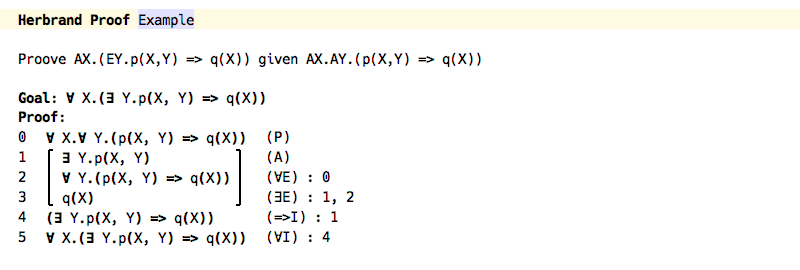

The proof is validated using experimental type checking with constraint rules, which is a new feature being developed for MPS. The sentences that constitute judgements in the proof are represented as terms in the internal language of constraint rules. The inference rules use terms unification to match sentences and extract sub-sentences. Every judgement is assigned a conclusion and, if the judgement is proved to be correct, it is marked as valid.
Here is a sample of an inference rule written in the language of constraint rules processing.

This rule is activated when all of the following is true:
- The judgement
neis assigned a conclusion (captured inCon) - The judgement’s premise is assigned a conclusion
- The premise’s conclusion matches
~~Con - The premise is valid
The result of the rule’s activation is simply that the judgement ne is marked as valid.
Inner workings
Rule templates are applied to each of the reasoning nodes and produce a constraint rules program, that is then evaluated. First the automatic rules, the rules that are always generated, are triggered, which activate constraint conclusion binding reasoning to the propositional term corresponding to the sentence contained in the reasoning.
Propositional Logic rules

Constraint valid signifies the validity of a reasoning. Premise and Assumption are valid automatically. Reiteration is valid if its conclusion matches the conclusion of the judgement being reiterated.

Activated constraints conclusion and valid trigger the rest of the constraint rules, which correspond to inference rules.
The formal definition of And Introduction and And Elimination inference rules are the following.

For simplicity, in this sample project we restrict ourselves to only two conjunctions, but we should account for premises being enumerated in any order. Here are the two inference rules for conjunction in the language of constraint rules.
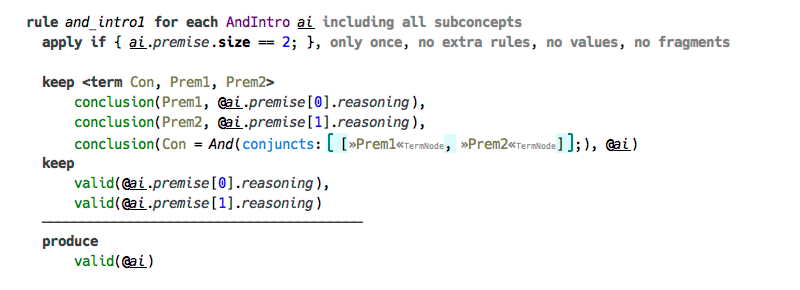

All inference rules are organised similarly: the premises (the part above the horizontal separator) are the input, which triggers the rule, and the conclusion is what the rule produces. All constraints in the input part are to be «kept», that is they are stored for future use by other rules after this rule completes.

As with conjunction, we only support two disjunct in a disjunction, but their order can be arbitrary.

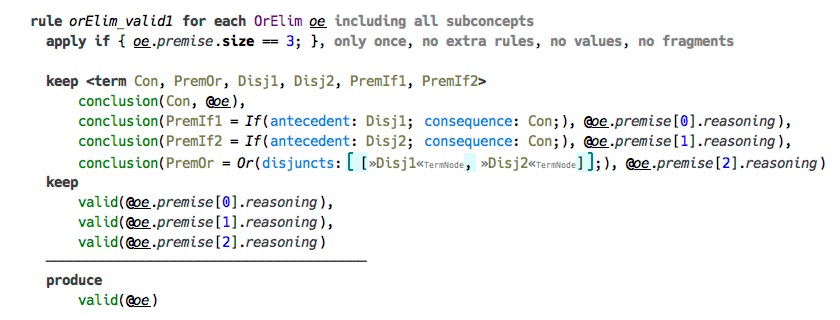

Negation introduction requires two premises, but their order is not specified, so we have two versions of an inference rule to account for this. There is only one version of Negation Elimination inference rule.


In the case of Implication Introduction the premise is not a judgement, but a subproof. We need to create one additional rule for the singular case, whereas the subproof serving as the premise has only the assumption. This is because we’re referring to both the first and the last judgments in the subproof, and the rule requires both to have a conclusion in the form of a constraint, which in the case of a singular assumption is the same constraint.


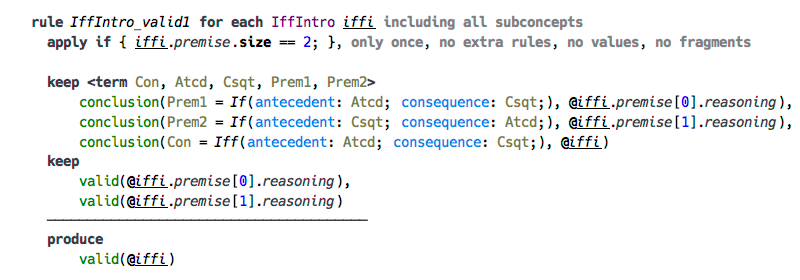
There are two versions of both Biconditional Introduction and Biconditional Elimination rules to account for arbitrary order of premises and arbitrary selection of the conclusion.

Herbrand Logic rules


Structure of both inference rules follows strictly the definitions above. Since there are certain conditions that must be met for rules to be applicable, these are extracted in boolean variables that are checked with assert() constraint, which is built-in into the language of constraint rules. If assertion fails, the alternative branch is triggered, which assigns an error message to the judgement.
An important detail is the presence of when clause, which tests that the corresponding terms in premises and the conclusion are matched after a successful substitution. The construct subst(TERM [MATCH -> REPLACEMENT]) serves the purpose of producing the term that is the result of a substitution.


As with rules for Universal quantifier, Existential Introduction and Elimination rules follow the formal definitions, both checking for correct unification of terms and asserting that the variable is chosen correctly in case of elimination.
First Order Logic rules

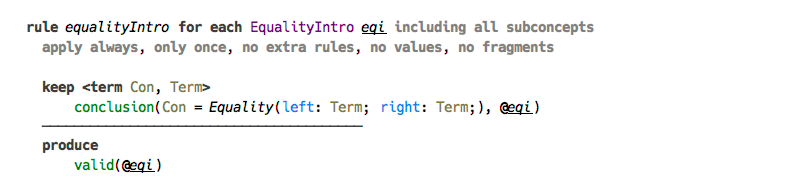

First Order Logic introduces only one rule of interest, since Equality Introduction is not really useful. And the pattern here is the same as with Universal and Existential rules.
Goal
The constraint goal is activated automatically to associate the goal of the proof with its formal sentence.

The proof’s goal is unified with the last top-level reasoning. Since reasonings are organised in a hierarchy using subproofs, the last reasoning in the proof is automatically the last top-level one. If that reasoning is marked valid, so is the goal.

Type checking
The actual type checking is trivial. The first stage of the constraint rules program does all the job and produces valid constraints, which are to be analysed in the second stage. All reasonings are checked in the second stage, and the reasonings that don’t have valid constraint are marked with error.
There is only one type «OK». Only the goal gets assigned a type in case it marked as valid, otherwise an error is produced.
License
Copyright 2014-2018 JetBrains s.r.o.
Licensed under the Apache License, Version 2.0 (the "License"); you may not use this file except in compliance with the License. You may obtain a copy of the License at
http://www.apache.org/licenses/LICENSE-2.0
Unless required by applicable law or agreed to in writing, software distributed under the License is distributed on an "AS IS" BASIS, WITHOUT WARRANTIES OR CONDITIONS OF ANY KIND, either express or implied. See the License for the specific language governing permissions and limitations under the License.