<!--

If you know who should review your pull request, please assign it to
that
person, otherwise the pull request would get assigned randomly.

If your pull request is for a specific language, please add the
appropriate
lang label.

-->
Move the SSL_CTX to the level of the credentials rather than the
subchannel.
The SSL_CTX should only get created once per credential rather than once
per subchannel.

We should observe no behavior change with this PR, only efficiency
gains.
Most recent attempt was #34320, reverted in #34335.

The first commit here is a pure revert. The second commit fixes the
outlier_detection unit test to pass both with and without the
experiment.
<!--

If you know who should review your pull request, please assign it to
that
person, otherwise the pull request would get assigned randomly.

If your pull request is for a specific language, please add the
appropriate
lang label.

-->
@ctiller PTAL for core configuration changes. I converted the type from
std::function to absl::AnyInvocable. Do you think the functor in
RegisteredBuilder should be callable just once or multiple times?
<!--

If you know who should review your pull request, please assign it to
that
person, otherwise the pull request would get assigned randomly.

If your pull request is for a specific language, please add the
appropriate
lang label.

-->
Changes -
1) Change local mesh labels to not be reported on 'started' metrics at
all (even those that we know about) to be consistent. (Since xDS labels
atleast on the server side would not be available on started metric.)
2) Add mesh_id as a local label that is populated by reading the xDS
bootstrap. As part of this, also added a minimal xds bootstrap parsing
logic.

<!--

If you know who should review your pull request, please assign it to
that
person, otherwise the pull request would get assigned randomly.

If your pull request is for a specific language, please add the
appropriate
lang label.

-->
This should address one of the failures we're seeing in #34224.

The test failure is caused by the changes in timing triggering a race
condition. In the code at head, we delay sending out the subscription
for the first CDS watch until we've already seen the other two CDS
watches, because the previous send_message op has not yet completed, and
by the time it does, we've seen all 3 watches, so we can send a
subscription for all 3 at the same time. With the WorkSerializer change,
the send_message op is complete by the time we see the first CDS watch,
so we subscribe to only that resource, and then later add the other two.
The result is that we'll NACK twice with two different messages, the
first one including only the error about the first resource, and the
second one including all three.

I suspect this same race condition would have been triggered eventually
by the EventEngine migration anyway; the current test basically depends
on the single-thread timing of the iomgr approach. So I'm addressing it
by replacing the e2e test with a unit test that covers the same cases
without the timing issue.
Rolls forward part of the dualstack changes, mostly from #33427 and a
little bit from #32692, both of which were reverted in #33718.
Specifically:
- For petiole policies, unconditionally start health watch on
subchannels, even if client side health checking is not enabled; in this
case, the health watch will report the subchannel's raw connectivity
state.
- Fix edge cases in health check reporting that occur when a watcher is
started before the initial state is reported.
- When client-side health checking fails, add the subchannel's address
to the RPC failure status message.
- Outlier detection now works only via the health checking watch, not
via the raw connectivity state watch.
- Remove now-unnecessary hack to ensure that outlier detection does not
work for pick_first.
A new metadata type `x-envoy-peer-metadata` is being introduced. We
don't have a better way to do this at the moment compared to just adding
it in `metadata_batch.h`.

The GSM Observability plugin uses this metadata to send topology
information to peers in the form of serialized and base64 encoded
`google::protobuf::Struct`. The individual keys being used inside the
struct are subject to change.

<!--

If you know who should review your pull request, please assign it to
that
person, otherwise the pull request would get assigned randomly.

If your pull request is for a specific language, please add the
appropriate
lang label.

-->
Based on updates at https://github.com/grpc/proposal/pull/380

<!--

If you know who should review your pull request, please assign it to
that
person, otherwise the pull request would get assigned randomly.

If your pull request is for a specific language, please add the
appropriate
lang label.

-->
<!--

If you know who should review your pull request, please assign it to
that
person, otherwise the pull request would get assigned randomly.

If your pull request is for a specific language, please add the
appropriate
lang label.

-->

---------

Co-authored-by: Mark D. Roth <roth@google.com>
Co-authored-by: markdroth <markdroth@users.noreply.github.com>
Co-authored-by: ctiller <ctiller@users.noreply.github.com>
Old message:
new_cluster_1: UNAVAILABLE: errors validating xds_cluster_resolver LB
policy config: [field:discoveryMechanisms error:must be non-empty]

New message:
new_cluster_1: FAILED_PRECONDITION: aggregate cluster graph has no leaf
clusters
If we get a readable event on an fd and both the following happens:

- c-ares does *not* read all bytes off the fd

- c-ares removes the fd from the set ARES_GETSOCK_READABLE

... then we have a busy loop here, where we'd keep asking c-ares to
process an fd that it no longer cares about.

This is indirectly related to a change in this code one month ago:
https://github.com/grpc/grpc/pull/33942 - before that change, c-ares
would close the socket when it called
[handle_error](7f3262312f/src/lib/ares_process.c (L707))
and so `IsFdStillReadableLocked` would start returning `false`, causing
us to get away with [this
loop](f6a994229e/src/core/ext/filters/client_channel/resolver/dns/c_ares/grpc_ares_wrapper.cc (L371)).
Now, because `IsFdStillReadableLocked` will keep returning true (because
of our overridden `close` API), we'll loop forever.
Based on updates at https://github.com/grpc/proposal/pull/380
<!--

If you know who should review your pull request, please assign it to
that
person, otherwise the pull request would get assigned randomly.

If your pull request is for a specific language, please add the
appropriate
lang label.

-->
We added this as an exploratory measure for a customer that thought they
were using open census (this turned out to be emphatically false).
Remove it since it's probably not how we ultimately want to do this, and
wait for something better to come along.

---------

Co-authored-by: ctiller <ctiller@users.noreply.github.com>
This makes the resolver component tests suite run on Window RBE by
adding a flag in the test driver to further differentiate between Bazel
local run and Bazel RBE run on Windows since they have different
RUNFILES behavior.

Local Bazel run succeeds:
```
C:\Users\yijiem\projects\grpc>bazel --output_base=C:\bazel2 test --dynamic_mode=off --verbose_failures --test_arg=--running_locally=true //test/cpp/naming:resolver_component_tests_runner_invoker
INFO: Analyzed target //test/cpp/naming:resolver_component_tests_runner_invoker (0 packages loaded, 0 targets configured).
INFO: Found 1 test target...
Target //test/cpp/naming:resolver_component_tests_runner_invoker up-to-date:
  bazel-bin/test/cpp/naming/resolver_component_tests_runner_invoker.exe
INFO: Elapsed time: 196.080s, Critical Path: 193.21s
INFO: 2 processes: 1 internal, 1 local.
INFO: Build completed successfully, 2 total actions
//test/cpp/naming:resolver_component_tests_runner_invoker                PASSED in 193.1s

Executed 1 out of 1 test: 1 test passes.
```

RBE run succeeds:
```
C:\Users\yijiem\projects\grpc>bazel --bazelrc=tools/remote_build/windows.bazelrc test --config=windows_opt --dynamic_mode=off --verbose_failures --host_linkopt=/NODEFAULTLIB:libcmt.lib --host_linkopt=/DEFAULTLIB:msvcrt.lib --nocache_test_results //test/cpp/naming:resolver_component_tests_runner_invoker
INFO: Invocation ID: d467f2e3-7da6-4bb5-8b9b-84f1181ebc60
WARNING: --remote_upload_local_results is set, but the remote cache does not support uploading action results or the current account is not authorized to write local results to the remote cache.
INFO: Streaming build results to: https://source.cloud.google.com/results/invocations/d467f2e3-7da6-4bb5-8b9b-84f1181ebc60
INFO: Analyzed target //test/cpp/naming:resolver_component_tests_runner_invoker (0 packages loaded, 133 targets configured).
INFO: Found 1 test target...
Target //test/cpp/naming:resolver_component_tests_runner_invoker up-to-date:
  bazel-bin/test/cpp/naming/resolver_component_tests_runner_invoker.exe
INFO: Elapsed time: 41.627s, Critical Path: 39.42s
INFO: 2 processes: 1 internal, 1 remote.
//test/cpp/naming:resolver_component_tests_runner_invoker                PASSED in 33.0s

Executed 1 out of 1 test: 1 test passes.
INFO: Streaming build results to: https://source.cloud.google.com/results/invocations/d467f2e3-7da6-4bb5-8b9b-84f1181ebc60
INFO: Build completed successfully, 2 total actions
```


<!--

If you know who should review your pull request, please assign it to
that
person, otherwise the pull request would get assigned randomly.

If your pull request is for a specific language, please add the
appropriate
lang label.

-->
This reverts commit fe1ba18dfc.

Reason: break import


<!--

If you know who should review your pull request, please assign it to
that
person, otherwise the pull request would get assigned randomly.

If your pull request is for a specific language, please add the
appropriate
lang label.

-->
This helps developers run benchmark loadtests locally. See comments in
scenario_runner.py for usage.

---------

Co-authored-by: drfloob <drfloob@users.noreply.github.com>
Local Bazel invocation succeeds:

```
C:\Users\yijiem\projects\grpc>bazel --output_base=C:\bazel2 test --dynamic_mode=off --verbose_failures //test/cpp/naming:resolver_component_tests_runner_invoker@poller=epoll1
INFO: Analyzed target //test/cpp/naming:resolver_component_tests_runner_invoker@poller=epoll1 (0 packages loaded, 0 targets configured).
INFO: Found 1 test target...
Target //test/cpp/naming:resolver_component_tests_runner_invoker@poller=epoll1 up-to-date:
  bazel-bin/test/cpp/naming/resolver_component_tests_runner_invoker@poller=epoll1.exe
INFO: Elapsed time: 199.262s, Critical Path: 193.48s
INFO: 2 processes: 1 internal, 1 local.
INFO: Build completed successfully, 2 total actions
//test/cpp/naming:resolver_component_tests_runner_invoker@poller=epoll1  PASSED in 193.4s

Executed 1 out of 1 test: 1 test passes.
```

The local invocation of RBE failed with linker error `LINK : error
LNK2001: unresolved external symbol mainCRTStartup`, but that does not
limited to this target:
https://gist.github.com/yijiem/2c6cbd9a31209a6de8fd711afbf2b479.

<!--

If you know who should review your pull request, please assign it to
that
person, otherwise the pull request would get assigned randomly.

If your pull request is for a specific language, please add the
appropriate
lang label.

-->
Update from gtcooke94:
This PR adds support to build gRPC and it's tests with OpenSSL3. There were some
hiccups with tests as the tests with openssl haven't been built or exercised in a
few months, so they needed some work to fix.

Right now I expect all test files to pass except the following:
- h2_ssl_cert_test
- ssl_transport_security_utils_test

I confirmed locally that these tests fail with OpenSSL 1.1.1 as well,
thus we are at least not introducing regressions. Thus, I've added compiler directives around these tests so they only build when using BoringSSL.

---------

Co-authored-by: Gregory Cooke <gregorycooke@google.com>
Co-authored-by: Esun Kim <veblush@google.com>
CNR the flake, but I've changed the test (which is very old) to use some
of our more modern helper functions that have saner timeouts.

Also re-add a `return` statement that was accidentally removed in
#33753, which I noticed while working on this. Its absence doesn't cause
a real problem, but it does cause us to needlessly trigger a duplicate
connection attempt or report a duplicate CONNECTING update in some
cases.
De-experiment pick first since we have both affinity and randomness E2E
test running successfully.

---------

Co-authored-by: Yash Tibrewal <yashkt@google.com>
<!--

If you know who should review your pull request, please assign it to
that
person, otherwise the pull request would get assigned randomly.

If your pull request is for a specific language, please add the
appropriate
lang label.

-->
This PR is mainly a set of improvements that allow the C++ Alarm to be
migrated away from legacy iomgr. It cannot be landed without significant
speedup, due to third-parties relying on a fast path for immediate timer
execution with deadlines <= now.

Previous EventEngine performance of bm_alarm, compared to baseline iomgr
timers: *0.014%*
This PR: *2.5%*

Regarding previous failures to land this change: The cloud libraries
team agreed to reduce the amount of stress in their alarm stress test
https://github.com/googleapis/google-cloud-cpp/pull/12378
Fix sticky-TF behavior such that once we enter TRANSIENT_FAILURE, we do
not leave that state if we get a new address list.

Also, fix handling of subchannels in state TRANSIENT_FAILURE.
Previously, if a subchannel was already in state TRANSIENT_FAILURE when
we wanted to start a connection attempt on it (e.g., because the
subchannel already existed from a different channel, or because it
already existed in the previous subchannel list), we would wait for it
to report IDLE before attempting to connect. This PR changes pick_first
to instead immediately skip the subchannel and move on to the next one.
Now, the only time we wait for a subchannel in TRANSIENT_FAILURE is when
we wrap back around to the first subchannel in the list.
Port https://github.com/grpc/grpc/pull/33871 to EE's
GrpcPolledFdFactoryPosix.

<!--

If you know who should review your pull request, please assign it to
that
person, otherwise the pull request would get assigned randomly.

If your pull request is for a specific language, please add the
appropriate
lang label.

-->
<!--

If you know who should review your pull request, please assign it to
that
person, otherwise the pull request would get assigned randomly.

If your pull request is for a specific language, please add the
appropriate
lang label.

-->
Not adding CMake support yet

<!--

If you know who should review your pull request, please assign it to
that
person, otherwise the pull request would get assigned randomly.

If your pull request is for a specific language, please add the
appropriate
lang label.

-->
We decided to not populate `policy_name` with the HTTP filter name in
xDS case. So removing it from `GenerateServiceConfig`. This will be
consistent across languages. The gRFC
[PR](https://github.com/grpc/proposal/pull/346) has been updated.
<!--

If you know who should review your pull request, please assign it to
that
person, otherwise the pull request would get assigned randomly.

If your pull request is for a specific language, please add the
appropriate
lang label.

-->
I'm fairly certain that this path should be non-blocking (and making it
so makes the promise based code far more tractable).

This moves the blocking behavior into the blocking server_cc.cc function
that calls `grpc_server_shutdown_and_notify` instead of in that
non-blocking function.

---------

Co-authored-by: ctiller <ctiller@users.noreply.github.com>
The previous version (`3.12`) is 7 years old and does not support the
newest Python 3 versions. This causes issues to move certain test
targets (which depends on `pyyaml`) to Python 3 when some CI environment
(e.g. `arm64v8/debian:11`) does not have Python 2 installed. And in
general, we should move away from Python 2. Thus, updated `pyyaml` to
the latest version.

This hopefully should also fix the
`prod:grpc/core/master/linux/arm64/grpc_bazel_test_c_cpp` job breakage.

<!--

If you know who should review your pull request, please assign it to
that
person, otherwise the pull request would get assigned randomly.

If your pull request is for a specific language, please add the
appropriate
lang label.

-->
Rolls forward https://github.com/grpc/grpc/pull/33871

Second and third commits here fix internal build issues

In particular, add a `// IWYU pragma: no_include <ares_build.h>` since
`ares.h` [includes that
anyways](bad62225b7/include/ares.h (L23))
(and seems unlikely for that to change since it would be breaking)
Normally, c-ares related fds are destroyed after all DNS resolution is
finished in [this code
path](c82d31677a/src/core/ext/filters/client_channel/resolver/dns/c_ares/grpc_ares_wrapper.cc (L210)).
Also there are some fds that c-ares may fail to open or write to
initially, and c-ares will close them internally before grpc ever knows
about them.

But if:
1) c-ares opens a socket and successfully writes a request on it
2) then a subsequent read fails

Then c-ares will close the fd in [this code
path](bad62225b7/src/lib/ares_process.c (L740)),
but gRPC will have a reference on the fd and will still use it
afterwards.

Fix here is to leverage the c-ares socket-override API to properly track
fd ownership between c-ares and grpc.

Related: internal issue b/292203138
<!--

If you know who should review your pull request, please assign it to
that
person, otherwise the pull request would get assigned randomly.

If your pull request is for a specific language, please add the
appropriate
lang label.

-->
<!--

If you know who should review your pull request, please assign it to
that
person, otherwise the pull request would get assigned randomly.

If your pull request is for a specific language, please add the
appropriate
lang label.

-->
This PR implements a c-ares based DNS resolver for EventEngine with the
reference from the original
[grpc_ares_wrapper.h](../blob/master/src/core/ext/filters/client_channel/resolver/dns/c_ares/grpc_ares_wrapper.h).
The PosixEventEngine DNSResolver is implemented on top of that. Tests
which use the client channel resolver API
([resolver.h](../blob/master/src/core/lib/resolver/resolver.h#L54)) are
ported, namely the
[resolver_component_test.cc](../blob/master/test/cpp/naming/resolver_component_test.cc)
and the
[cancel_ares_query_test.cc](../blob/master/test/cpp/naming/cancel_ares_query_test.cc).
The WindowsEventEngine DNSResolver will use the same EventEngine's
grpc_ares_wrapper and will be worked on next.

The
[resolve_address_test.cc](https://github.com/grpc/grpc/blob/master/test/core/iomgr/resolve_address_test.cc)
which uses the iomgr
[DNSResolver](../blob/master/src/core/lib/iomgr/resolve_address.h#L44)
API has been ported to EventEngine's dns_test.cc. That leaves only 2
tests which use iomgr's API, notably the
[dns_resolver_cooldown_test.cc](../blob/master/test/core/client_channel/resolvers/dns_resolver_cooldown_test.cc)
and the
[goaway_server_test.cc](../blob/master/test/core/end2end/goaway_server_test.cc)
which probably need to be restructured to use EventEngine DNSResolver
(for one thing they override the original grpc_ares_wrapper's free
functions). I will try to tackle these in the next step.
<!--

If you know who should review your pull request, please assign it to
that
person, otherwise the pull request would get assigned randomly.

If your pull request is for a specific language, please add the
appropriate
lang label.

-->
This test has been disabled for a long time now due to flakiness, but
it's now causing problems with the import. And stress tests don't
provide positive ROI anyway, so let's just get rid of it.
Note that the plugin is still under `grpc::internal` namespace and not
under `experimental` intentionally.

<!--

If you know who should review your pull request, please assign it to
that
person, otherwise the pull request would get assigned randomly.

If your pull request is for a specific language, please add the
appropriate
lang label.

-->
This reverts the following PRs: #32692#33087#33093#33427#33568
These changes seem to have introduced some flaky crashes. Reverting
while I investigate.
As per gRFC A58, when WRR sees a subchannel report READY, it reset the
non_empty_since value, thus restarting the blackout period. However,
there were two cases where we were incorrectly triggering this code:
1. When WRR got an updated address list that contained addresses that
were already present on the old list and whose subchannels were already
in READY state, the initial notification for those subchannels on the
new list was READY, which incorrectly triggered resetting the
non_empty_since value.
2. Due to a bug in the outlier_detection policy, whenever an update was
propagated down through the OD policy without actually enabling OD, it
would incorrectly send a duplicate connectivity state notification for
the subchannels. This meant that a subchannel that was already in state
READY would report READY again, which would also incorrectly trigger
resetting the non_empty_since value.

This PR makes two changes:
1. Fix the bug in outlier_detection that caused it to generate the
spurious duplicate READY updates.
2. Fix WRR to reset the non_empty_since value when a subchannel goes
READY only if the subchannel has seen a previous state update and only
if that previous state was not READY. (The duplicate READY notifications
should not actually happen anymore now that the OD policy has been
fixed, but better to be defensive.)

Fixes b/290983884.
In real services most of our time ends up in the `Read1()` function,
which populates one byte into the bit buffer.
Change this to read in as many as possible bytes at a time into that
buffer.

Additionally, generate all possible (to some depth) parser geometries,
and add a benchmark for them. Run that benchmark and select the best
geometry for decoding base64 strings (since this is the main use-case).

(gives about a 30% speed boost parsing base64 then huffman encoded
random binary strings)

---------

Co-authored-by: ctiller <ctiller@users.noreply.github.com>
More work on the dualstack backend design:
- Now that all petiole policies have been changed to delegate to
pick_first, outlier detection no longer needs to eject via the
subchannel's raw connectivity state; it can now eject only via the
health state. See #33340.
- This also removes the now-unnecessary hack to explicitly disable
outlier detection in pick_first. See #33336.
More work on the dualstack backend design:
- Change ring_hash policy to delegate to pick_first instead of creating
subchannels directly.
- Note that, as mentioned in the WIP gRFC, because we lazily create the
pick_first child policies, so there's no need to swap over to a new list
as an atomic whole. As a result, we don't use the endpoint_list library
in this policy; instead, we just update a map in-place.
- Remove now-unused subchannel_list library.
More work on the dualstack backend design:
- Change round_robin to delegate to pick_first instead of creating
subchannels directly.
- Change pick_first such that when it is the child of a petiole policy,
it will unconditionally start a health watch.
- Change the client-side health checking code such that if client-side
health checking is not enabled, it will return the subchannel's raw
connectivity state.
- As part of this, we introduce a new endpoint_list library to be used
by petiole policies, which is intended to replace the existing
subchannel_list library. The only policy that will still directly
interact with subchannels is pick_first, so the relevant parts of the
subchannel_list functionality have been copied directly into that
policy. The subchannel_list library will be removed after all petiole
policies are updated to delegate to pick_first.
Add bazel dependency on opentelemetry-cpp.
<!--

If you know who should review your pull request, please assign it to
that
person, otherwise the pull request would get assigned randomly.

If your pull request is for a specific language, please add the
appropriate
lang label.

-->
The address attribute interface was intended to provide a mechanism to
pass attributes separately from channel args, for values that do not
affect subchannel behavior and therefore do not need to be present in
the subchannel key, which does include channel args. However, the
mechanism as currently designed is fairly clunky and is probably not the
direction we will want to go in the long term.

Eventually, we will want some mechanism for registering channel args,
which would provide a cleaner way to indicate that a given channel arg
should not be used in the subchannel key, so that we don't need a
completely different mechanism. For now, this PR is just doing an
interim step, which is to establish a special channel arg key prefix to
indicate that an arg is not needed in the subchannel key.
<!--

If you know who should review your pull request, please assign it to
that
person, otherwise the pull request would get assigned randomly.

If your pull request is for a specific language, please add the
appropriate
lang label.

-->
The following bugs are fixed:

* Missing ExecCtx in event engine endpoints and listeners
* Ref counting issue with iomgr endpoint which causes crashes in
overloaded situations

The PR includes a test which triggers these bugs by simulating an
overloaded system.
- Switched  from yapf to black
- Reconfigure isort for black
- Resolve black/pylint idiosyncrasies

Note: I used `--experimental-string-processing` because black was
producing "implicit string concatenation", similar to what described
here: https://github.com/psf/black/issues/1837. While currently this
feature is experimental, it will be enabled by default:
https://github.com/psf/black/issues/2188. After running black with the
new string processing so that the generated code merges these `"hello" "
world"` strings concatenations, then I removed
`--experimental-string-processing` for stability, and regenerated the
code again.

To the reviewer: don't even try to open "Files Changed" tab 😄 It's
better to review commit-by-commit, and ignore `run black and isort`.
<!--

If you know who should review your pull request, please assign it to
that
person, otherwise the pull request would get assigned randomly.

If your pull request is for a specific language, please add the
appropriate
lang label.

-->
Following improvements were made to `orca_oob` interop test to increase
compatibility and stability:

1. Timeout was increased to 10s (see #33098)
2. Server will block clients trying to run this test concurrently.
3. Data is cleared in the beginning of the call.
Added tests involve:
1. Checking the # of logger invocations with multiple RBACs in the
chain.
2. Verifying content in audit context with action and audit condition
permutations.
3. Confirm custom logger and built-in logger configurations are working.
4. Confirm the feature is protected by the environment variable.

---------

Co-authored-by: rockspore <rockspore@users.noreply.github.com>
- switch to json_object_loader for config parsing
- use `absl::string_view` instead of `const char*` for cert provider
names
- change cert provider registry to use a map instead of a vector
- remove unused mesh_ca cert provider factory
I generated a new client key and cert where a Spiffe ID is added as the
URI SAN. As such, we are able to test the audit log contains the
principal correctly.

Update: I switched to use the test logger to verify the log content and
removed stdout logger here because one the failure of [RBE Windows Debug
C/C++](https://source.cloud.google.com/results/invocations/c3187f41-bb1f-44b3-b2b1-23f38e47386d).

Update again: Refactored the test logger in a util such that the authz
engine test also uses the same logger. Subsequently, xDS e2e test will
also use it.

---------

Co-authored-by: rockspore <rockspore@users.noreply.github.com>
Upgrade apple platform deployment_target versions to fix the cocoapods
push of BoringSSL-GRPC about the following error:
```
ld: file not found: /Applications/Xcode.app/Contents/Developer/Toolchains/XcodeDefault.xctoolchain/usr/lib/arc/libarclite_macosx.a
clang: error: linker command failed with exit code 1 (use -v to see invocation)
```
ref: https://developer.apple.com/forums/thread/725300

This also aligns with the versions required by
[protobuf](https://github.com/protocolbuffers/protobuf/pull/10652)

```
ios.deployment_target = '10.0'
osx.deployment_target = '10.12'
tvos.deployment_target = '12.0'
watchos.deployment_target = '6.0'
```
`tools/run_tests/sanity/check_absl_mutex.sh` was broken, a missing paren
crashed the script if run locally. It's unclear yet how our sanity
checks were not complaining about this, `run_tests.py` does not save the
log.
This makes the JSON API visible as part of the C-core API, but in the
`experimental` namespace. It will be used as part of various
experimental APIs that we will be introducing in the near future, such
as the audit logging API.
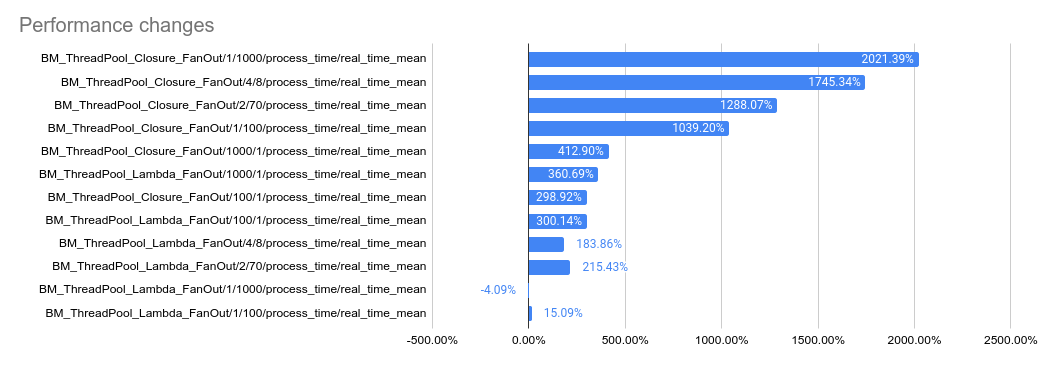
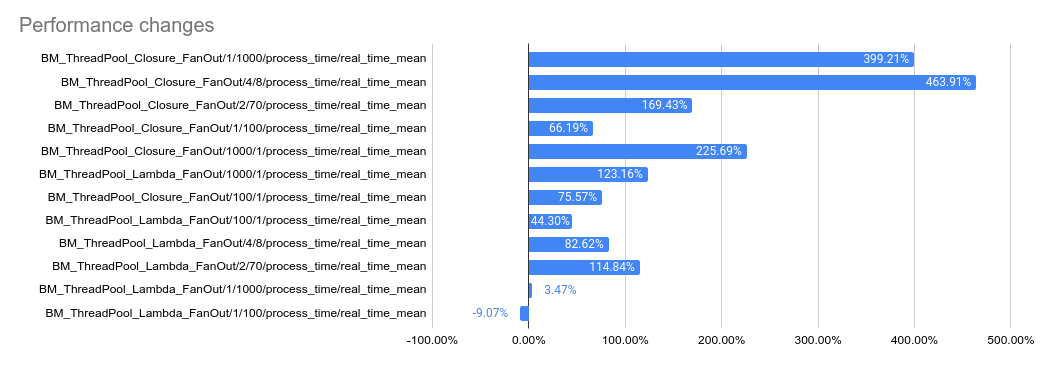
This PR implements a work-stealing thread pool for use inside
EventEngine implementations. Because of historical risks here, I've
guarded the new implementation behind an experiment flag:
`GRPC_EXPERIMENTS=work_stealing`. Current default behavior is the
original thread pool implementation.
Benchmarks look very promising:
```
bazel test \
--test_timeout=300 \
--config=opt -c opt \
--test_output=streamed \
--test_arg='--benchmark_format=csv' \
--test_arg='--benchmark_min_time=0.15' \
--test_arg='--benchmark_filter=_FanOut' \
--test_arg='--benchmark_repetitions=15' \
--test_arg='--benchmark_report_aggregates_only=true' \
test/cpp/microbenchmarks:bm_thread_pool
```
2023-05-04: `bm_thread_pool` benchmark results on my local machine (64
core ThreadRipper PRO 3995WX, 256GB memory), comparing this PR to
master:
2023-05-04: `bm_thread_pool` benchmark results in the Linux RBE
environment (unsure of machine configuration, likely small), comparing
this PR to master.
---------
Co-authored-by: drfloob <drfloob@users.noreply.github.com>
Reverts grpc/grpc#33002. Breaks internal builds:
`.../privacy_context:filters does not depend on a module exporting
'.../src/core/lib/channel/context.h'`
Change call attributes to be stored in a `ChunkedVector` instead of
`std::map<>`, so that the storage can be allocated on the arena. This
means that we're now doing a linear search instead of a map lookup, but
the total number of attributes is expected to be low enough that that
should be okay.

Also, we now hide the actual data structure inside of the
`ServiceConfigCallData` object, which required some changes to the
`ConfigSelector` API. Previously, the `ConfigSelector` would return a
`CallConfig` struct, and the client channel would then use the data in
that struct to populate the `ServiceConfigCallData`. This PR changes
that such that the client channel creates the `ServiceConfigCallData`
before invoking the `ConfigSelector`, and it passes the
`ServiceConfigCallData` into the `ConfigSelector` so that the
`ConfigSelector` can populate it directly.
<!--

If you know who should review your pull request, please assign it to
that
person, otherwise the pull request would get assigned randomly.

If your pull request is for a specific language, please add the
appropriate
lang label.

-->
<!--

If you know who should review your pull request, please assign it to
that
person, otherwise the pull request would get assigned randomly.

If your pull request is for a specific language, please add the
appropriate
lang label.

-->
As Protobuf is going to support Cord to reduce memory copy when
[de]serializing Cord fields, gRPC is going to leverage it. This
implementation is based on the internal one but it's slightly modified
to use the public APIs of Cord. only
<!--

If you know who should review your pull request, please assign it to
that
person, otherwise the pull request would get assigned randomly.

If your pull request is for a specific language, please add the
appropriate
lang label.

-->
This bug occurred when the same xDS server was configured twice in the
same bootstrap config, once in an authority and again as the top-level
server. In that case, we were incorrectly failing to de-dup them and
were creating a separate channel for the LRS stream than the one that
already existed for the ADS stream. We fix this by canonicalizing the
server keys the same way in both cases.

As a separate follow-up item, I will work on trying to find a better way
to key these maps that does not suffer from this kind of fragility.
We shouldn't depend on how much the compression algorithm compresses the
bytes to. This is causing flakiness internally.

<!--

If you know who should review your pull request, please assign it to
that
person, otherwise the pull request would get assigned randomly.

If your pull request is for a specific language, please add the
appropriate
lang label.

-->
Expand server promises to run with C++ end2end tests.

Across connected_channel/call/batch_builder/pipe/transport:
- fix a bug where read errors weren't propagated from transport to call
so that we can populate failed_before_recv_message for the c++ bindings
- ensure those errors are not, however, used to populate the returned
call status

Add a new latch call arg to lazily propagate the bound CQ for a server
call (and client call, but here it's used degenerately - it's always
populated). This allows server calls to be properly bound to
pollsets.(1)/(2)

In call.cc:
- move some profiling code from FilterStackCall to Call, and then use it
in PromiseBasedCall (this should be cleaned up with tracing work)
- implement GetServerAuthority

In server.cc:
- use an RAII pattern on `MatchResult` to avoid a bug whereby a tag
could be dropped if we cancel a request after it's been matched but
before it's published
- fix deadline export to ServerContext

In resource_quota_server.cc:
- fix some long standing flakes (that were finally obvious with the new
test code) - it's legal here to have client calls not arrive at the
server due to resource starvation, work through that (includes adding
expectations during a `Step` call, which required some small tweaks to
cq_verifier)

In the C++ end2end_test.cc:
- strengthen a flaky test so it passes consistently (it's likely we'll
revisit this with the fuzzing efforts to strengthen it into an actually
robust test)

(1) It's time to remove this concept
(2) Surprisingly the only test that *reliably* demonstrates this not
being done is time_change_test

---------

Co-authored-by: ctiller <ctiller@users.noreply.github.com>
This reverts commit 4b46dbc19e.

Reason: this seems to be breaking load reports in certain cases,
b/276944116

Let's revert so this doesn't accidentally get released.
This PR aims to de-experimentalize the APIs for GCP Observability.

We would have ideally wanted public feedback before declaring the APIs
stable, but we need stable APIs for GA.

Changes made after API review with @markdroth @veblush, @ctiller and the
entire Core/C++ team -
* The old experimental APIs `grpc::experimental::GcpObservabilityInit`
and `grpc::experimental::GcpObservabilityClose` are now deprecated and
will be deleted after v.1.55 release.
* The new API gets rid of the Close method and follows the RAII idiom
with a single `grpc::GcpObservability::Init()` call that returns an
`GcpObservability` object, the lifetime of which controls when
observability data is flushed.
* The `GcpObservability` class could in the future add more methods. For
example, a debug method that shows the current configuration.
* Document that GcpObservability initialization and flushing (on
`GcpObservability` destruction) are blocking calls.
* Document that gRPC is still usable if GcpObservability initialization
failed. (Added a test to prove the same).
* Since we don't have a good way to flush stats and tracing with
OpenCensus, the examples required users to sleep for 25 seconds. This
sleep is now part of `GcpObservability` destruction.

Additional Implementation details -
* `GcpObservability::Init` is now marked with `GRPC_MUST_USE_RESULT` to
make sure that the results are used. We ideally want users to store it,
but this is better than nothing.
* Added a note on GCP Observability lifetime guarantees.

<!--

If you know who should review your pull request, please assign it to
that
person, otherwise the pull request would get assigned randomly.

If your pull request is for a specific language, please add the
appropriate
lang label.

-->
Notes:
- `+trace` fixtures haven't run since 2016, so they're disabled for now
(7ad2d0b463 (diff-780fce7267c34170c1d0ea15cc9f65a7f4b79fefe955d185c44e8b3251cf9e38R76))
- all current fixtures define `FEATURE_MASK_SUPPORTS_AUTHORITY_HEADER`
and hence `authority_not_supported` has not been run in years - deleted
- bad_hostname similarly hasn't been triggered in a long while, so
deleted
- load_reporting_hook has never been enabled, so deleted
(f23fb4cf31/test/core/end2end/generate_tests.bzl (L145-L148))
- filter_latency & filter_status_code rely on global variables and so
don't convert particularly cleanly - and their value seems marginal, so
deleted

---------

Co-authored-by: ctiller <ctiller@users.noreply.github.com>
This PR also centralizes the client channel resolver selection. Resolver
selection is still done using the plugin system, but when the Ares and
native client channel resolvers go away, we can consider bootstrapping
this differently.
<!--

If you know who should review your pull request, please assign it to
that
person, otherwise the pull request would get assigned randomly.

If your pull request is for a specific language, please add the
appropriate
lang label.

-->
<!--

If you know who should review your pull request, please assign it to
that
person, otherwise the pull request would get assigned randomly.

If your pull request is for a specific language, please add the
appropriate
lang label.

-->

---------

Co-authored-by: ctiller <ctiller@users.noreply.github.com>
Implement listeners, connection, endpoints for `FuzzingEventEngine`.
Allows the fuzzer to select write sizes and delays, connection delays,
and port assignments.

I made a few modifications to the test suite to admit this event engine
to pass the client & server tests:
1. the test factories return shared_ptr<> to admit us to return the same
event engine for both the oracle and the implementation - necessary
because FuzzingEventEngine forms a closed world of addresses & ports.
2. removed the WaitForSingleOwner calls - these seem unnecessary, and we
don't ask our users to do this - tested existing linux tests 1000x
across debug, asan, tsan with this change

Additionally, the event engine overrides the global port picker logic so
that port assignments are made by the fuzzer too.

This PR is a step along a longer journey, and has some outstanding
brethren PR's, and some follow-up work:
* #32603 will convert all the core e2e tests into a more malleable form
* we'll then use #32667 to turn all of these into fuzzers
* finally we'll integrate this into that work and turn all core e2e
tests into fuzzers over timer & callback reorderings and io
size/spacings

---------

Co-authored-by: ctiller <ctiller@users.noreply.github.com>
This reverts commit 7bd9267f32.


<!--

If you know who should review your pull request, please assign it to
that
person, otherwise the pull request would get assigned randomly.

If your pull request is for a specific language, please add the
appropriate
lang label.

-->
(hopefully last try)

Add new channel arg GRPC_ARG_ABSOLUTE_MAX_METADATA_SIZE as hard limit
for metadata. Change GRPC_ARG_MAX_METADATA_SIZE to be a soft limit.
Behavior is as follows:

Hard limit
(1) if hard limit is explicitly set, this will be used.
(2) if hard limit is not explicitly set, maximum of default and soft
limit * 1.25 (if soft limit is set) will be used.

Soft limit
(1) if soft limit is explicitly set, this will be used.
(2) if soft limit is not explicitly set, maximum of default and hard
limit * 0.8 (if hard limit is set) will be used.

Requests between soft and hard limit will be rejected randomly, requests
above hard limit will be rejected.
<!--

If you know who should review your pull request, please assign it to
that
person, otherwise the pull request would get assigned randomly.

If your pull request is for a specific language, please add the
appropriate
lang label.

-->

---------

Co-authored-by: ctiller <ctiller@users.noreply.github.com>
<!--

If you know who should review your pull request, please assign it to
that
person, otherwise the pull request would get assigned randomly.

If your pull request is for a specific language, please add the
appropriate
lang label.

-->
Earlier, we were simply using a 64 bit random number, but the spec
actually calls for UUIDv4.

<!--

If you know who should review your pull request, please assign it to
that
person, otherwise the pull request would get assigned randomly.

If your pull request is for a specific language, please add the
appropriate
lang label.

-->
This PR is a small code change with a lot of new test data.
[In OpenSSL, there are two flags that configure CRL checks. Coping
relevant
section:](https://www.openssl.org/docs/man1.0.2/man3/X509_VERIFY_PARAM_get_depth.html)

> - X509_V_FLAG_CRL_CHECK enables CRL checking for the certificate chain
leaf certificate. An error occurs if a suitable CRL cannot be found.
> - X509_V_FLAG_CRL_CHECK_ALL enables CRL checking for the entire
certificate chain.

We currently only set `X509_V_FLAG_CRL_CHECK`, so we will only ever
check if the leaf certificate is revoked. We should check the whole
chain. I am open to making this a user configuration if we want to do it
that way, but we certainly need to be able to check the whole chain.

So, this PR contains the small code change in
`ssl_transport_security.cc` to use the `X509_V_FLAG_CRL_CHECK_ALL` flag.
Then the rest of the changes are in tests. I've added all the necessary
files to have a chain built that looks as follows
`Root CA -> Revoked Intermediate CA -> Leaf Certificate`, and added a
test for this case as well.
You can verify that on master this new test will fail (i.e. the
handshake will succeed even though the intermediate CA is revoked) by
checking out this branch, running `git checkout master --
./src/core/tsi/ssl_transport_security.cc`, then running the test.

I also slightly reorganized test/core/tsi/test_creds/ so that the CRLs
are in their own directory, which is the way our API intends to accept
CRLs.
Fixing TSAN data races of the kind -
https://source.cloud.google.com/results/invocations/c3f02253-0d0b-44e6-917d-07e4bc0d3d62/targets/%2F%2Ftest%2Fcpp%2Fperformance:writes_per_rpc_test@poller%3Dpoll/log

I think the original issue was the non-atomic load in
writes_per_rpc_test.cc but also making the change to use barriers
instead of relaxed atomics (probably unimportant but I'll prefer safety
in the absence of otherwise comments).

Could probably also use std::atomic but feeling a bit lazy to make the
changes throughout.

<!--

If you know who should review your pull request, please assign it to
that
person, otherwise the pull request would get assigned randomly.

If your pull request is for a specific language, please add the
appropriate
lang label.

-->
<!--

If you know who should review your pull request, please assign it to
that
person, otherwise the pull request would get assigned randomly.

If your pull request is for a specific language, please add the
appropriate
lang label.

-->
This PR adds the view `grpc.io/client/api_latency` for GCP Observability
which aims to collect the end-to-end time taken by a call.

Changes made to support this -
1) A global interceptor factory registration is created for stats
plugins.
2) OpenCensus plugin now provides a new interceptor that's responsible
for collecting the new latency.
3) Gcp Observability registers this plugin.
4) A new OpenCensus measurement and view is created for api latency.
Note that this is internal as of now, since it's not clear if it should
be exposed as public experimental API. Leaving that decision for the
future.

<!--

If you know who should review your pull request, please assign it to
that
person, otherwise the pull request would get assigned randomly.

If your pull request is for a specific language, please add the
appropriate
lang label.

-->
This PR adds annotations to client attempt spans and server spans on
messages of the form -
* `Send message: 1026 bytes`
* `Send compressed message: 31 bytes` (if message was compressed)
* `Received message: 31 bytes`
* `Received decompressed message: 1026 bytes` (if message needed to be
decompressed)

Note that the compressed and decompressed annotations are not present if
compression/decompression was not performed.

<!--

If you know who should review your pull request, please assign it to
that
person, otherwise the pull request would get assigned randomly.

If your pull request is for a specific language, please add the
appropriate
lang label.

-->
This is a big rewrite of global config.

It does a few things, all somewhat intertwined:
1. centralize the list of configuration we have to a yaml file that can
be parsed, and code generated from it
2. add an initialization and a reset stage so that config vars can be
centrally accessed very quickly without the need for caching them
3. makes the syntax more C++ like (less macros!)
4. (optionally) adds absl flags to the OSS build

This first round of changes is intended to keep the system where it is
without major changes. We pick up absl flags to match internal code and
remove one point of deviation - but importantly continue to read from
the environment variables. In doing so we don't force absl flags on our
customers - it's possible to configure grpc without the flags - but
instead allow users that do use absl flags to configure grpc using that
mechanism. Importantly this lets internal customers configure grpc the
same everywhere.

Future changes along this path will be two-fold:
1. Move documentation generation into the code generation step, so that
within the source of truth yaml file we can find all documentation and
data about a configuration knob - eliminating the chance of forgetting
to document something in all the right places.
2. Provide fuzzing over configurations. Currently most config variables
get stashed in static constants across the codebase. To fuzz over these
we'd need a way to reset those cached values between fuzzing rounds,
something that is terrifically difficult right now, but with these
changes should simply be a reset on `ConfigVars`.

<!--

If you know who should review your pull request, please assign it to
that
person, otherwise the pull request would get assigned randomly.

If your pull request is for a specific language, please add the
appropriate
lang label.

-->

---------

Co-authored-by: ctiller <ctiller@users.noreply.github.com>
We currently take named metrics recorded per-request only. Instead we
should merge field-wise.

<!--

If you know who should review your pull request, please assign it to
that
person, otherwise the pull request would get assigned randomly.

If your pull request is for a specific language, please add the
appropriate
lang label.

-->
1. Make channel creation lazy. This allows test cases to update the
configuration before the connection is made.
2. Pass load reports tracker when creating the policy. This way other
test cases do not see any changes to ChannelArguments.

Using grpc_core::CoreConfiguration::RunWithSpecialConfiguration was
considered but did not work as it removes other builders setup prior to
starting the test cases.
<!--

If you know who should review your pull request, please assign it to
that
person, otherwise the pull request would get assigned randomly.

If your pull request is for a specific language, please add the
appropriate
lang label.

-->

---------

Co-authored-by: ctiller <ctiller@users.noreply.github.com>
<!--

If you know who should review your pull request, please assign it to
that
person, otherwise the pull request would get assigned randomly.

If your pull request is for a specific language, please add the
appropriate
lang label.

-->
It is reported in https://github.com/grpc/grpc/issues/32356 that there
is a race on vptr for `UnimplementedAsyncRequest` which would cause
crashes for multi-threaded server if clients send unimplemented RPC
request to the server.

The cause is that the server requests a call for
`UnimplementedAsyncRequest` in its base class `GenericAsyncRequest` when
the `vptr` still points to the base class's `vtable`. If the call went
in and another server thread picks up the tag before the `vptr` points
back to the derived class's `vtable`, it would call the wrong virtual
function and also this is a data race. This fix makes the request of the
call inside the derived class's constructor.

<!--

If you know who should review your pull request, please assign it to
that
person, otherwise the pull request would get assigned randomly.

If your pull request is for a specific language, please add the
appropriate
lang label.

-->
<!--

If you know who should review your pull request, please assign it to
that
person, otherwise the pull request would get assigned randomly.

If your pull request is for a specific language, please add the
appropriate
lang label.

-->
PR #32215 added the verified root cert subject to the lower level
`tsi_peer`. This PR is a companion to that and completes the feature by
bubbling the information up to the `TsiCustomVerificationCheckRequest`
which is part of the user facing API for implementing custom
verification callbacks.
Third try for #32466.

This adds an interop client / server for GCP Observability integration
testing.

Everything is new here with no refactor. Plan is to get this in first
before trying to refactor out the flags.
Refactor C++ interop test client flags into the common
`client_helper.h/cc`. This is needed by the observability testing PR
#32466

We need the `ABSL_DECLARE_FLAG` in the header file so that we can share
that across different implementation.
<!--

If you know who should review your pull request, please assign it to
that
person, otherwise the pull request would get assigned randomly.

If your pull request is for a specific language, please add the
appropriate
lang label.

-->
This filter was originally written only for the C++ wrapped layer, but
we have plans to use this for Python (and maybe other wrapped languages
too in the future.)

<!--

If you know who should review your pull request, please assign it to
that
person, otherwise the pull request would get assigned randomly.

If your pull request is for a specific language, please add the
appropriate
lang label.

-->
 Craig Tiller

