<!--

If you know who should review your pull request, please assign it to
that
person, otherwise the pull request would get assigned randomly.

If your pull request is for a specific language, please add the
appropriate
lang label.

-->
<!--

If you know who should review your pull request, please assign it to
that
person, otherwise the pull request would get assigned randomly.

If your pull request is for a specific language, please add the
appropriate
lang label.

-->

---------

Co-authored-by: ctiller <ctiller@users.noreply.github.com>
<!--

If you know who should review your pull request, please assign it to
that
person, otherwise the pull request would get assigned randomly.

If your pull request is for a specific language, please add the
appropriate
lang label.

-->

---------

Co-authored-by: ctiller <ctiller@users.noreply.github.com>
- switch to json_object_loader for config parsing
- use `absl::string_view` instead of `const char*` for cert provider
names
- change cert provider registry to use a map instead of a vector
- remove unused mesh_ca cert provider factory
Allow usage in production tasks

<!--

If you know who should review your pull request, please assign it to
that
person, otherwise the pull request would get assigned randomly.

If your pull request is for a specific language, please add the
appropriate
lang label.

-->
I generated a new client key and cert where a Spiffe ID is added as the
URI SAN. As such, we are able to test the audit log contains the
principal correctly.

Update: I switched to use the test logger to verify the log content and
removed stdout logger here because one the failure of [RBE Windows Debug
C/C++](https://source.cloud.google.com/results/invocations/c3187f41-bb1f-44b3-b2b1-23f38e47386d).

Update again: Refactored the test logger in a util such that the authz
engine test also uses the same logger. Subsequently, xDS e2e test will
also use it.

---------

Co-authored-by: rockspore <rockspore@users.noreply.github.com>
Parties prefer to wakeup inline, however there are some mechanisms that
want an out-of-line wakeup (say due to a previously held mutex that may
be re-taken). To help those cases permit a guaranteed asynchronous
wakeup.

(needed now for resolver wakeups on the client call path)
- Accept JSON null for any optional field.
- Do *not* accept JSON null for wrapper types (`absl::optional<>`,
`std::unique_ptr<>`, and `RefCountedPtr<>`) that are *not* marked as
optional fields.
(This is a re-open PR for https://github.com/grpc/grpc/pull/32999, which
was closed accidentally due to the branch re-base and force-push)

Implement the frame serialization/deserialization method in chaotic-good
transport.

Previous comments from Craig:
- Since messages are not part of the framing system anymore, I think we
should remove ReceiveMessage (and therefore ReceivePadding) from this
type.
(instead we should add some helper functions to get the message lengths)
-- Resolved

- This approach will cause all frame manipulation code to know about
this serialization detail, rather than just the code that's serializing
it - I think it would be better to keep the type, flags separation (even
if we need to change the flags representation)
-- Done, changed back to type, flags separation.

<!--

If you know who should review your pull request, please assign it to
that
person, otherwise the pull request would get assigned randomly.

If your pull request is for a specific language, please add the
appropriate
lang label.

-->
Will be used to evaluate experiment effects on memory usage once they're
toggled on.

<!--

If you know who should review your pull request, please assign it to
that
person, otherwise the pull request would get assigned randomly.

If your pull request is for a specific language, please add the
appropriate
lang label.

-->
Upgrade apple platform deployment_target versions to fix the cocoapods
push of BoringSSL-GRPC about the following error:
```
ld: file not found: /Applications/Xcode.app/Contents/Developer/Toolchains/XcodeDefault.xctoolchain/usr/lib/arc/libarclite_macosx.a
clang: error: linker command failed with exit code 1 (use -v to see invocation)
```
ref: https://developer.apple.com/forums/thread/725300

This also aligns with the versions required by
[protobuf](https://github.com/protocolbuffers/protobuf/pull/10652)

```
ios.deployment_target = '10.0'
osx.deployment_target = '10.12'
tvos.deployment_target = '12.0'
watchos.deployment_target = '6.0'
```
This test mode tries to create threads wherever it legally can to
maximize the chances of TSAN finding errors in our codebase.

<!--

If you know who should review your pull request, please assign it to
that
person, otherwise the pull request would get assigned randomly.

If your pull request is for a specific language, please add the
appropriate
lang label.

-->

---------

Co-authored-by: ctiller <ctiller@users.noreply.github.com>
This PR adds lookup cancellation to the client channel resolver fuzzer,
and adds an optional call to `resolver->Orphan()` at a few specific
points.

I also significantly sped up the fuzzer by removing all mutexes, waits,
and sleeps. It's single-threaded, after all.

---------

Co-authored-by: drfloob <drfloob@users.noreply.github.com>
Use an index instead of a string to select tests (and use that index
module total test count to ensure whatever the fuzzer selects we always
run a test).

This will make the fuzzer corpus unstable when the test count changes,
which I think is fine - it'll regenerate.

<!--

If you know who should review your pull request, please assign it to
that
person, otherwise the pull request would get assigned randomly.

If your pull request is for a specific language, please add the
appropriate
lang label.

-->
ChannelArgs fuzz configuration is expected to be used in other fuzzing
targets as well. This PR extracts the common code from the API fuzzer
and converts to use the C++ types.
Allow for multiple `--grpc_experiments`, `--grpc_trace` command line
arguments to be added, accumulate them, and provide them to gRPC as one
thing.

<!--

If you know who should review your pull request, please assign it to
that
person, otherwise the pull request would get assigned randomly.

If your pull request is for a specific language, please add the
appropriate
lang label.

-->

---------

Co-authored-by: ctiller <ctiller@users.noreply.github.com>
Early out evaluating this function where we can, and use macros to
eliminate function calls in debug builds.

Takes per-example time from 5400ms to 1200ms in debug asan builds.

<!--

If you know who should review your pull request, please assign it to
that
person, otherwise the pull request would get assigned randomly.

If your pull request is for a specific language, please add the
appropriate
lang label.

-->

---------

Co-authored-by: ctiller <ctiller@users.noreply.github.com>
This reverts commit 1624542ea4, relanding
https://github.com/grpc/grpc/pull/32956

Because of some proto dependency and build problems internally, I've
removed the ServiceConfig proto fuzzing component. These build issues
can hopefully be resolved soon, and then we can re-add the deleted
implementation from commit
[b078c9c](b078c9c015)
in this PR.
Rare bug: server initial metadata gets stranded in the outbound pipe.
(fix is a little unpleasant, but we'll do better at the five pipes
stage)

<!--

If you know who should review your pull request, please assign it to
that
person, otherwise the pull request would get assigned randomly.

If your pull request is for a specific language, please add the
appropriate
lang label.

-->
The logger uses `absl::FPrintF` to write to stdout. After reading a
number of sources online, I got the impression that `std::fwrite` which
is used by `absl::FPrintF` is atomic so there is no locking required
here.

---------

Co-authored-by: rockspore <rockspore@users.noreply.github.com>
This metadata doesn't actually encode so passing it through from an app
will force a crash.
<!--

If you know who should review your pull request, please assign it to
that
person, otherwise the pull request would get assigned randomly.

If your pull request is for a specific language, please add the
appropriate
lang label.

-->
Instead just Utf-16 encode the null byte when dumping the value to a
string form.

<!--

If you know who should review your pull request, please assign it to
that
person, otherwise the pull request would get assigned randomly.

If your pull request is for a specific language, please add the
appropriate
lang label.

-->
<!--

If you know who should review your pull request, please assign it to
that
person, otherwise the pull request would get assigned randomly.

If your pull request is for a specific language, please add the
appropriate
lang label.

-->
Fixes `FakeXdsTransport` to remove itself from the map in
`FakeXdsTransportFactory` when it gets orphaned by the `XdsClient`, so
that a subsequent creation of a new transport for the same server does
not trigger an assertion due to the transport already existing in the
map.

Fixes internal b/259362837.
Was leading to a nullptr deref, and we just don't need this one anymore.

<!--

If you know who should review your pull request, please assign it to
that
person, otherwise the pull request would get assigned randomly.

If your pull request is for a specific language, please add the
appropriate
lang label.

-->
Avoids long path name problems on Windows
<!--

If you know who should review your pull request, please assign it to
that
person, otherwise the pull request would get assigned randomly.

If your pull request is for a specific language, please add the
appropriate
lang label.

-->
Add a new binary that runs all core end2end tests in fuzzing mode.

In this mode FuzzingEventEngine is substituted for the default event
engine. This means that time is simulated, as is IO. The FEE gets
control of callback delays also.

In our tests the `Step()` function becomes, instead of a single call to
`completion_queue_next`, a series of calls to that function and
`FuzzingEventEngine::Tick`, driving forward the event loop until
progress can be made.

PR guide:
---

**New binaries**
`core_end2end_test_fuzzer` - the new fuzzer itself
`seed_end2end_corpus` - a tool that produces an interesting seed corpus

**Config changes for safe fuzzing**
The implementation tries to use the config fuzzing work we've previously
deployed in api_fuzzer to fuzz across experiments. Since some
experiments are far too experimental to be safe in such fuzzing (and
this will always be the case):
- a new flag is added to experiments to opt-out of this fuzzing
- a new hook is added to the config system to allow variables to
re-write their inputs before setting them during the fuzz

**Event manager/IO changes**
Changes are made to the event engine shims so that tcp_server_posix can
run with a non-FD carrying EventEngine. These are in my mind a bit
clunky, but they work and they're in code that we expect to delete in
the medium term, so I think overall the approach is good.

**Changes to time**
A small tweak is made to fix a bug initializing time for fuzzers in
time.cc - we were previously failing to initialize
`g_process_epoch_cycles`

**Changes to `Crash`**
A version that prints to stdio is added so that we can reliably print a
crash from the fuzzer.

**Changes to CqVerifier**
Hooks are added to allow the top level loop to hook the verification
functions with a function that steps time between CQ polls.

**Changes to end2end fixtures**
State machinery moves from the fixture to the test infra, to keep the
customizations for fuzzing or not in one place. This means that fixtures
are now just client/server factories, which is overall nice.

It did necessitate moving some bespoke machinery into
h2_ssl_cert_test.cc - this file is beginning to be problematic in
borrowing parts but not all of the e2e test machinery. Some future PR
needs to solve this.

A cq arg is added to the Make functions since the cq is now owned by the
test and not the fixture.

**Changes to test registration**
`TEST_P` is replaced by `CORE_END2END_TEST` and our own test registry is
used as a first depot for test information.

The gtest version of these tests: queries that registry to manually
register tests with gtest. This ultimately changes the name of our tests
again (I think for the last time) - the new names are shorter and more
readable, so I don't count this as a regression.

The fuzzer version of these tests: constructs a database of fuzzable
tests that it can consult to look up a particular suite/test/config
combination specified by the fuzzer to fuzz against. This gives us a
single fuzzer that can test all 3k-ish fuzzing ready tests and cross
polinate configuration between them.

**Changes to test config**
The zero size registry stuff was causing some problems with the event
engine feature macros, so instead I've removed those and used GTEST_SKIP
in the problematic tests. I think that's the approach we move towards in
the future.

**Which tests are included**
Configs that are compatible - those that do not do fd manipulation
directly (these are incompatible with FuzzingEventEngine), and those
that do not join threads on their shutdown path (as these are
incompatible with our cq wait methodology). Each we can talk about in
the future - fd manipulation would be a significant expansion of
FuzzingEventEngine, and is probably not worth it, however many uses of
background threads now should probably evolve to be EventEngine::Run
calls in the future, and then would be trivially enabled in the fuzzers.

Some tests currently fail in the fuzzing environment, a
`SKIP_IF_FUZZING` macro is used for these few to disable them if in the
fuzzing environment. We'll burn these down in the future.

**Changes to fuzzing_event_engine**
Changes are made to time: an exponential sweep forward is used now -
this catches small time precision things early, but makes decade long
timers (we have them) able to be used right now. In the future we'll
just skip time forward to the next scheduled timer, but that approach
doesn't yet work due to legacy timer system interactions.

Changes to port assignment: we ensure that ports are legal numbers
before assigning them via `grpc_pick_port_or_die`.

A race condition between time checking and io is fixed.

---------

Co-authored-by: ctiller <ctiller@users.noreply.github.com>
Currently, we are not very consistent in what we assume the initial
state of an LB policy will be and whether or not we assume that it will
immediately report a new picker when it gets its initial address update;
different parts of our code make different assumptions. This PR
establishes the convention that LB policies will be assumed to start in
state CONNECTING and will *not* be assumed to report a new picker
immediately upon getting their initial address update, and we now assume
that convention everywhere consistently.

This is a preparatory step for changing policies like round_robin to
delegate to pick_first, which I'm working on in #32692. As part of that
change, we need pick_first to not report a connectivity state until it
actually sees the connectivity state of the underlying subchannels, so
that round_robin knows when to swap over to a new child list without
reintroducing the problem fixed in #31939.
To fix this error

```
test/core/security/grpc_authorization_engine_test.cc:88:32: error: unknown type name 'Json'; did you mean 'experimental::Json'?
  ParseAuditLoggerConfig(const Json&) override {
                               ^~~~
                               experimental::Json
```
This makes the JSON API visible as part of the C-core API, but in the
`experimental` namespace. It will be used as part of various
experimental APIs that we will be introducing in the near future, such
as the audit logging API.
WireWriter implementation schedules actions to be run by `ExecCtx`. We
should flush pending actions before destructing
`end2end_testing::g_transaction_processor`, which need to be alive to
handle the scheduled actions. Otherwise,
we get heap-use-after-free error because the testing fixture
(`end2end_testing::g_transaction_processor`) is destructed before all
the scheduled actions are run.

This lowers end2end binder transport test failure rate from 0.23% to
0.15%, according to internal tool that runs the test for 15000 times
under various configuration.
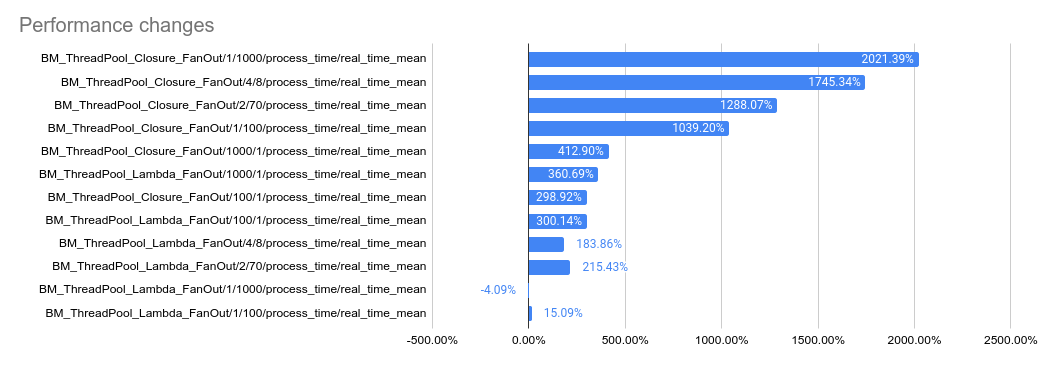
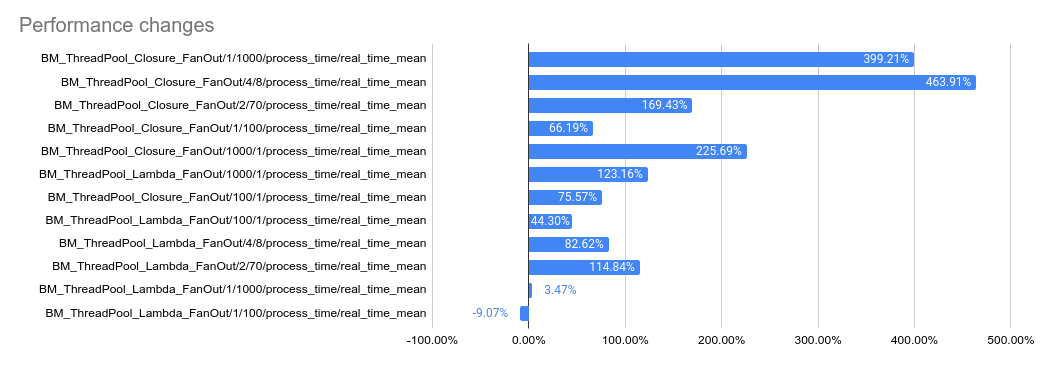
This PR implements a work-stealing thread pool for use inside
EventEngine implementations. Because of historical risks here, I've
guarded the new implementation behind an experiment flag:
`GRPC_EXPERIMENTS=work_stealing`. Current default behavior is the
original thread pool implementation.
Benchmarks look very promising:
```
bazel test \
--test_timeout=300 \
--config=opt -c opt \
--test_output=streamed \
--test_arg='--benchmark_format=csv' \
--test_arg='--benchmark_min_time=0.15' \
--test_arg='--benchmark_filter=_FanOut' \
--test_arg='--benchmark_repetitions=15' \
--test_arg='--benchmark_report_aggregates_only=true' \
test/cpp/microbenchmarks:bm_thread_pool
```
2023-05-04: `bm_thread_pool` benchmark results on my local machine (64
core ThreadRipper PRO 3995WX, 256GB memory), comparing this PR to
master:
2023-05-04: `bm_thread_pool` benchmark results in the Linux RBE
environment (unsure of machine configuration, likely small), comparing
this PR to master.
---------
Co-authored-by: drfloob <drfloob@users.noreply.github.com>
One TXT lookup query can return multiple TXT records (see the following
example). `EventEngine::DNSResolver` should return all of them to let
the caller (e.g. `event_engine_client_channel_resolver`) decide which
one they would use.

```
$ dig TXT wikipedia.org

; <<>> DiG 9.18.12-1+build1-Debian <<>> TXT wikipedia.org
;; global options: +cmd
;; Got answer:
;; ->>HEADER<<- opcode: QUERY, status: NOERROR, id: 49626
;; flags: qr rd ra; QUERY: 1, ANSWER: 3, AUTHORITY: 0, ADDITIONAL: 1

;; OPT PSEUDOSECTION:
; EDNS: version: 0, flags:; udp: 512
;; QUESTION SECTION:
;wikipedia.org.                 IN      TXT

;; ANSWER SECTION:
wikipedia.org.          600     IN      TXT     "google-site-verification=AMHkgs-4ViEvIJf5znZle-BSE2EPNFqM1nDJGRyn2qk"
wikipedia.org.          600     IN      TXT     "yandex-verification: 35c08d23099dc863"
wikipedia.org.          600     IN      TXT     "v=spf1 include:wikimedia.org ~all"
```

Note that this change also deviates us from the iomgr's DNSResolver API
which uses std::string as the result type.


<!--

If you know who should review your pull request, please assign it to
that
person, otherwise the pull request would get assigned randomly.

If your pull request is for a specific language, please add the
appropriate
lang label.

-->
Reverts grpc/grpc#32924. This breaks the build again, unfortunately.

From `test/core/event_engine/cf:cf_engine_test`:

```
error: module .../grpc/test/core/event_engine/cf:cf_engine_test does not depend on a module exporting 'grpc/support/port_platform.h'
```

@sampajano I recommend looking into CI tests to catch iOS problems
before merging. We can enable EventEngine experiments in the CI
generally once this PR lands, but this broken test is not one of those
experiments. A normal build should have caught this.

cc @HannahShiSFB
Reverts grpc/grpc#33002. Breaks internal builds:
`.../privacy_context:filters does not depend on a module exporting
'.../src/core/lib/channel/context.h'`
Change call attributes to be stored in a `ChunkedVector` instead of
`std::map<>`, so that the storage can be allocated on the arena. This
means that we're now doing a linear search instead of a map lookup, but
the total number of attributes is expected to be low enough that that
should be okay.

Also, we now hide the actual data structure inside of the
`ServiceConfigCallData` object, which required some changes to the
`ConfigSelector` API. Previously, the `ConfigSelector` would return a
`CallConfig` struct, and the client channel would then use the data in
that struct to populate the `ServiceConfigCallData`. This PR changes
that such that the client channel creates the `ServiceConfigCallData`
before invoking the `ConfigSelector`, and it passes the
`ServiceConfigCallData` into the `ConfigSelector` so that the
`ConfigSelector` can populate it directly.
The protection is added at `xds_http_rbac_filter.cc` where we read the
new field. With this disabling the feature, nothing from things like
`xds_audit_logger_registry.cc` shall be invoked.
Makes some awkward fixes to compression filter, call, connected channel
to hold the semantics we have upheld now in tests.

Once the fixes described here
https://github.com/grpc/grpc/blob/master/src/core/lib/channel/connected_channel.cc#L636
are in this gets a lot less ad-hoc, but that's likely going to be
post-landing promises client & server side.

We specifically need special handling for server side cancellation in
response to reads wrt the inproc transport - which doesn't track
cancellation thoroughly enough itself.

<!--

If you know who should review your pull request, please assign it to
that
person, otherwise the pull request would get assigned randomly.

If your pull request is for a specific language, please add the
appropriate
lang label.

-->

---------

Co-authored-by: ctiller <ctiller@users.noreply.github.com>
<!--

If you know who should review your pull request, please assign it to
that
person, otherwise the pull request would get assigned randomly.

If your pull request is for a specific language, please add the
appropriate
lang label.

-->
1. `GrpcAuthorizationEngine` creates the logger from the given config in
its ctor.
2. `Evaluate()` invokes audit logging when needed.

---------

Co-authored-by: rockspore <rockspore@users.noreply.github.com>
Whilst the per cpu counters probably help single channel contention, we
think it's likely that they're a pessimization when taken fleetwide.

<!--

If you know who should review your pull request, please assign it to
that
person, otherwise the pull request would get assigned randomly.

If your pull request is for a specific language, please add the
appropriate
lang label.

-->
Add audit condition and audit logger config into `grpc_core::Rbac`.
Support translation of audit logging options from authz policy to it.

Audit logging options in authz policy looks like:
```json
{
  "audit_logging_options": {
    "audit_condition": "ON_DENY",
    "audit_loggers": [
      {
        "name": "logger",
        "config": {},
        "is_optional": false
      }
    ]
  }
}
```
which is consistent with what's in the xDS RBAC proto but a little
flattened.

---------

Co-authored-by: rockspore <rockspore@users.noreply.github.com>
Audit logging APIs for both built-in loggers and third-party logger
implementations.

C++ uses using decls referring to C-Core APIs.

---------

Co-authored-by: rockspore <rockspore@users.noreply.github.com>
<!--

If you know who should review your pull request, please assign it to
that
person, otherwise the pull request would get assigned randomly.

If your pull request is for a specific language, please add the
appropriate
lang label.

-->

---------

Co-authored-by: ctiller <ctiller@users.noreply.github.com>
Third-party loggers will be added in subsequent PRs once the logger
factory APIs are available to validate the configs here.

This registry is used in `xds_http_rbac_filter.cc` to generate service
config json.
The PR also creates a separate BUILD target for:
- chttp2 context list
- iomgr buffer_list
- iomgr internal errqueue

This would allow the context list to be included as standalone
dependencies for EventEngine implementations.
In order to help https://github.com/grpc/grpc/pull/32748, change the
test so that it tells us what the problem is in the logs.

<!--

If you know who should review your pull request, please assign it to
that
person, otherwise the pull request would get assigned randomly.

If your pull request is for a specific language, please add the
appropriate
lang label.

-->
This test proves that `global_stats.IncrementHttp2MetadataSize(0)` works

<!--

If you know who should review your pull request, please assign it to
that
person, otherwise the pull request would get assigned randomly.

If your pull request is for a specific language, please add the
appropriate
lang label.

-->
- Added `fuzzer_input.proto` and `NetworkInput` proto message
- Migrated client_fuzzer and server_fuzzer to proto fuzzer
- Migrated the existing corpus and verified that the code coverage (e.g.
chttp2) stays the same

Probably need to cherrypick due to amount of files changed.

<!--

If you know who should review your pull request, please assign it to
that
person, otherwise the pull request would get assigned randomly.

If your pull request is for a specific language, please add the
appropriate
lang label.

-->
<!--

If you know who should review your pull request, please assign it to
that
person, otherwise the pull request would get assigned randomly.

If your pull request is for a specific language, please add the
appropriate
lang label.

-->
<!--

If you know who should review your pull request, please assign it to
that
person, otherwise the pull request would get assigned randomly.

If your pull request is for a specific language, please add the
appropriate
lang label.

-->

@sampajano
The very non-trivial upgrade of third_party/protobuf to 22.x
This PR strives to be as small as possible and many changes that were
compatible with protobuf 21.x and didn't have to be merged atomically
with the upgrade were already merged.
Due to the complexity of the upgrade, this PR wasn't created
automatically by a tool, but manually. Subsequent upgraded of
third_party/protobuf with our OSS release script should work again once
this change is merged.

This is best reviewed commit-by-commit, I tried to group changes in
logical areas.

Notable changes:
- the upgrade of third_party/protobuf submodule, the bazel protobuf
dependency itself
- upgrade of UPB dependency to 22.x (in the past, we used to always
upgrade upb to "main", but upb now has release branch as well). UPB
needs to be upgraded atomically with protobuf since there's a de-facto
circular dependency (new protobuf depends on new upb, which depends on
new protobuf for codegen).
- some protobuf and upb bazel rules are now aliases, so `
extract_metadata_from_bazel_xml.py` and `gen_upb_api_from_bazel_xml.py`
had to be modified to be able to follow aliases and reach the actual
aliased targets.
- some protobuf public headers were renamed, so especially
`src/compiler` needed to be updated to use the new headers.
- protobuf and upb now both depend on utf8_range project, so since we
bundle upb with grpc in some languages, we now have to bundle utf8_range
as well (hence changes in build for python, PHP, objC, cmake etc).
- protoc now depends on absl and utf8_range (previously protobuf had
absl dependency, but not for the codegen part), so python's
make_grpcio_tools.py required partial rewrite to be able to handle those
dependencies in the grpcio_tools build.
- many updates and fixes required for C++ distribtests (currently they
all pass, but we'll probably need to follow up, make protobuf's and
grpc's handling of dependencies more aligned and revisit the
distribtests)
- bunch of other changes mostly due to overhaul of protobuf's and upb's
internal build layout.

TODOs:
- [DONE] make sure IWYU and clang_tidy_code pass
- create a list of followups (e.g. work to reenable the few tests I had
to disable and to remove workaround I had to use)
- [DONE in cl/523706129] figure out problem(s) with internal import

---------

Co-authored-by: Craig Tiller <ctiller@google.com>
This enables the EventEngine experiments in end2end tests, excluding the
ResourceQuota tests which have known failures.

Some Windows tests are hanging, so they will be enabled later.

---------

Co-authored-by: drfloob <drfloob@users.noreply.github.com>
If an engine is created, it should be fully functional regardless of
whether gRPC-core experiments are on or off. The trade-off for now is
that when the core experiments are not enabled, the engine will be
slowly polling with nothing to do.

---------

Co-authored-by: drfloob <drfloob@users.noreply.github.com>
Expand server promises to run with C++ end2end tests.

Across connected_channel/call/batch_builder/pipe/transport:
- fix a bug where read errors weren't propagated from transport to call
so that we can populate failed_before_recv_message for the c++ bindings
- ensure those errors are not, however, used to populate the returned
call status

Add a new latch call arg to lazily propagate the bound CQ for a server
call (and client call, but here it's used degenerately - it's always
populated). This allows server calls to be properly bound to
pollsets.(1)/(2)

In call.cc:
- move some profiling code from FilterStackCall to Call, and then use it
in PromiseBasedCall (this should be cleaned up with tracing work)
- implement GetServerAuthority

In server.cc:
- use an RAII pattern on `MatchResult` to avoid a bug whereby a tag
could be dropped if we cancel a request after it's been matched but
before it's published
- fix deadline export to ServerContext

In resource_quota_server.cc:
- fix some long standing flakes (that were finally obvious with the new
test code) - it's legal here to have client calls not arrive at the
server due to resource starvation, work through that (includes adding
expectations during a `Step` call, which required some small tweaks to
cq_verifier)

In the C++ end2end_test.cc:
- strengthen a flaky test so it passes consistently (it's likely we'll
revisit this with the fuzzing efforts to strengthen it into an actually
robust test)

(1) It's time to remove this concept
(2) Surprisingly the only test that *reliably* demonstrates this not
being done is time_change_test

---------

Co-authored-by: ctiller <ctiller@users.noreply.github.com>
This error can trigger for either initial or trailing metadata (and
we've had outages where the latter was the cause).

I don't think we know at this layer if we're parsing initial or trailing
- though it'd be a good exercise to plumb that through.

For now remove the word initial because it's better to give less
information than wrong information.

<!--

If you know who should review your pull request, please assign it to
that
person, otherwise the pull request would get assigned randomly.

If your pull request is for a specific language, please add the
appropriate
lang label.

-->
This reverts commit 4b46dbc19e.

Reason: this seems to be breaking load reports in certain cases,
b/276944116

Let's revert so this doesn't accidentally get released.
<!--

If you know who should review your pull request, please assign it to
that
person, otherwise the pull request would get assigned randomly.

If your pull request is for a specific language, please add the
appropriate
lang label.

-->
Notes:
- `+trace` fixtures haven't run since 2016, so they're disabled for now
(7ad2d0b463 (diff-780fce7267c34170c1d0ea15cc9f65a7f4b79fefe955d185c44e8b3251cf9e38R76))
- all current fixtures define `FEATURE_MASK_SUPPORTS_AUTHORITY_HEADER`
and hence `authority_not_supported` has not been run in years - deleted
- bad_hostname similarly hasn't been triggered in a long while, so
deleted
- load_reporting_hook has never been enabled, so deleted
(f23fb4cf31/test/core/end2end/generate_tests.bzl (L145-L148))
- filter_latency & filter_status_code rely on global variables and so
don't convert particularly cleanly - and their value seems marginal, so
deleted

---------

Co-authored-by: ctiller <ctiller@users.noreply.github.com>
This commit adds support for using CIDR blocks defined in the `no_proxy`
environment variable. For example:
```
http_proxy=http://localhost:8080 no_proxy=10.10.0.0/24
```
The example above would bypass the proxy if the server IP matched
10.10.0.0 - 10.10.0.255.
Closes#22681
---------
Co-authored-by: Yash Tibrewal <yashkt@google.com>
<!--

If you know who should review your pull request, please assign it to
that
person, otherwise the pull request would get assigned randomly.

If your pull request is for a specific language, please add the
appropriate
lang label.

-->
Built atop #31448

Offers a simple framework for testing filters.

<!--

If you know who should review your pull request, please assign it to
that
person, otherwise the pull request would get assigned randomly.

If your pull request is for a specific language, please add the
appropriate
lang label.

-->

---------

Co-authored-by: ctiller <ctiller@users.noreply.github.com>
Add the capability for api-fuzzer to fuzz over different config
variables, to enable us to spot incompatible configurations there
sooner.

---------

Co-authored-by: ctiller <ctiller@users.noreply.github.com>
The logic is straightforward: attempt to read the
`GRPC_ALTS_MAX_CONCURRENT_HANDSHAKES` environment variable and, if it
set to an integer, instantiate the handshake queues based on this
integer.

Based on go/grpc-alts-concurrent-handshake-cap.
<!--

If you know who should review your pull request, please assign it to
that
person, otherwise the pull request would get assigned randomly.

If your pull request is for a specific language, please add the
appropriate
lang label.

-->

---------

Co-authored-by: ctiller <ctiller@users.noreply.github.com>
Implement listeners, connection, endpoints for `FuzzingEventEngine`.
Allows the fuzzer to select write sizes and delays, connection delays,
and port assignments.

I made a few modifications to the test suite to admit this event engine
to pass the client & server tests:
1. the test factories return shared_ptr<> to admit us to return the same
event engine for both the oracle and the implementation - necessary
because FuzzingEventEngine forms a closed world of addresses & ports.
2. removed the WaitForSingleOwner calls - these seem unnecessary, and we
don't ask our users to do this - tested existing linux tests 1000x
across debug, asan, tsan with this change

Additionally, the event engine overrides the global port picker logic so
that port assignments are made by the fuzzer too.

This PR is a step along a longer journey, and has some outstanding
brethren PR's, and some follow-up work:
* #32603 will convert all the core e2e tests into a more malleable form
* we'll then use #32667 to turn all of these into fuzzers
* finally we'll integrate this into that work and turn all core e2e
tests into fuzzers over timer & callback reorderings and io
size/spacings

---------

Co-authored-by: ctiller <ctiller@users.noreply.github.com>
This reverts commit 7bd9267f32.


<!--

If you know who should review your pull request, please assign it to
that
person, otherwise the pull request would get assigned randomly.

If your pull request is for a specific language, please add the
appropriate
lang label.

-->
(hopefully last try)

Add new channel arg GRPC_ARG_ABSOLUTE_MAX_METADATA_SIZE as hard limit
for metadata. Change GRPC_ARG_MAX_METADATA_SIZE to be a soft limit.
Behavior is as follows:

Hard limit
(1) if hard limit is explicitly set, this will be used.
(2) if hard limit is not explicitly set, maximum of default and soft
limit * 1.25 (if soft limit is set) will be used.

Soft limit
(1) if soft limit is explicitly set, this will be used.
(2) if soft limit is not explicitly set, maximum of default and hard
limit * 0.8 (if hard limit is set) will be used.

Requests between soft and hard limit will be rejected randomly, requests
above hard limit will be rejected.
<!--

If you know who should review your pull request, please assign it to
that
person, otherwise the pull request would get assigned randomly.

If your pull request is for a specific language, please add the
appropriate
lang label.

-->

---------

Co-authored-by: ctiller <ctiller@users.noreply.github.com>
Previously we triggered a flow control update when `announced <
target/2`, but if `target==1` then we fail to send a flow control update
(announced is never less than 1/2==0) and break our forward progress
guarantees.

b/259780449 internally.
<!--

If you know who should review your pull request, please assign it to
that
person, otherwise the pull request would get assigned randomly.

If your pull request is for a specific language, please add the
appropriate
lang label.

-->
<!--

If you know who should review your pull request, please assign it to
that
person, otherwise the pull request would get assigned randomly.

If your pull request is for a specific language, please add the
appropriate
lang label.

-->
Earlier, we were simply using a 64 bit random number, but the spec
actually calls for UUIDv4.

<!--

If you know who should review your pull request, please assign it to
that
person, otherwise the pull request would get assigned randomly.

If your pull request is for a specific language, please add the
appropriate
lang label.

-->
This allows us to replace `absl::optional<TaskHandle>` with checks
against the invalid handle.

This PR also replaces the differently-named invalid handle instances
with a uniform way of accessing static invalid instances across all
handle types, which aids a bit in testing.
Add an event manager that spawns threads just as much as it possibly
can... to expose TSAN to the myriad thread ordering problems in our code
base.

Next steps for this will be to add a new test mode for tsan + thready
event engine + a few other doodads to increase threads in the system
(party.cc in particular has a good place for a hook).

<!--

If you know who should review your pull request, please assign it to
that
person, otherwise the pull request would get assigned randomly.

If your pull request is for a specific language, please add the
appropriate
lang label.

-->

---------

Co-authored-by: ctiller <ctiller@users.noreply.github.com>
This PR is a small code change with a lot of new test data.
[In OpenSSL, there are two flags that configure CRL checks. Coping
relevant
section:](https://www.openssl.org/docs/man1.0.2/man3/X509_VERIFY_PARAM_get_depth.html)

> - X509_V_FLAG_CRL_CHECK enables CRL checking for the certificate chain
leaf certificate. An error occurs if a suitable CRL cannot be found.
> - X509_V_FLAG_CRL_CHECK_ALL enables CRL checking for the entire
certificate chain.

We currently only set `X509_V_FLAG_CRL_CHECK`, so we will only ever
check if the leaf certificate is revoked. We should check the whole
chain. I am open to making this a user configuration if we want to do it
that way, but we certainly need to be able to check the whole chain.

So, this PR contains the small code change in
`ssl_transport_security.cc` to use the `X509_V_FLAG_CRL_CHECK_ALL` flag.
Then the rest of the changes are in tests. I've added all the necessary
files to have a chain built that looks as follows
`Root CA -> Revoked Intermediate CA -> Leaf Certificate`, and added a
test for this case as well.
You can verify that on master this new test will fail (i.e. the
handshake will succeed even though the intermediate CA is revoked) by
checking out this branch, running `git checkout master --
./src/core/tsi/ssl_transport_security.cc`, then running the test.

I also slightly reorganized test/core/tsi/test_creds/ so that the CRLs
are in their own directory, which is the way our API intends to accept
CRLs.
Fixing TSAN data races of the kind -
https://source.cloud.google.com/results/invocations/c3f02253-0d0b-44e6-917d-07e4bc0d3d62/targets/%2F%2Ftest%2Fcpp%2Fperformance:writes_per_rpc_test@poller%3Dpoll/log

I think the original issue was the non-atomic load in
writes_per_rpc_test.cc but also making the change to use barriers
instead of relaxed atomics (probably unimportant but I'll prefer safety
in the absence of otherwise comments).

Could probably also use std::atomic but feeling a bit lazy to make the
changes throughout.

<!--

If you know who should review your pull request, please assign it to
that
person, otherwise the pull request would get assigned randomly.

If your pull request is for a specific language, please add the
appropriate
lang label.

-->
This is a big rewrite of global config.

It does a few things, all somewhat intertwined:
1. centralize the list of configuration we have to a yaml file that can
be parsed, and code generated from it
2. add an initialization and a reset stage so that config vars can be
centrally accessed very quickly without the need for caching them
3. makes the syntax more C++ like (less macros!)
4. (optionally) adds absl flags to the OSS build

This first round of changes is intended to keep the system where it is
without major changes. We pick up absl flags to match internal code and
remove one point of deviation - but importantly continue to read from
the environment variables. In doing so we don't force absl flags on our
customers - it's possible to configure grpc without the flags - but
instead allow users that do use absl flags to configure grpc using that
mechanism. Importantly this lets internal customers configure grpc the
same everywhere.

Future changes along this path will be two-fold:
1. Move documentation generation into the code generation step, so that
within the source of truth yaml file we can find all documentation and
data about a configuration knob - eliminating the chance of forgetting
to document something in all the right places.
2. Provide fuzzing over configurations. Currently most config variables
get stashed in static constants across the codebase. To fuzz over these
we'd need a way to reset those cached values between fuzzing rounds,
something that is terrifically difficult right now, but with these
changes should simply be a reset on `ConfigVars`.

<!--

If you know who should review your pull request, please assign it to
that
person, otherwise the pull request would get assigned randomly.

If your pull request is for a specific language, please add the
appropriate
lang label.

-->

---------

Co-authored-by: ctiller <ctiller@users.noreply.github.com>
Looking for something else I made some test additions, code tweaks to
make `Poll<>` better.

<!--

If you know who should review your pull request, please assign it to
that
person, otherwise the pull request would get assigned randomly.

If your pull request is for a specific language, please add the
appropriate
lang label.

-->
<!--

If you know who should review your pull request, please assign it to
that
person, otherwise the pull request would get assigned randomly.

If your pull request is for a specific language, please add the
appropriate
lang label.

-->

---------

Co-authored-by: ctiller <ctiller@users.noreply.github.com>
This change mostly aims to get OpenCensus to use the new
ServerCallTracer interface. Note that the interfaces nor the code are in
their final states. There are a bunch of moving pieces, but I thought
this might be a nice mid-step to check-in and make sure that our
internal traces can also work with these changes.

Overall changes -
1) call_tracer.h shows what the hierarchy of new call tracer interfaces
looks like. Open to renaming suggestions.
2) Moved most of the common interface between `CallAttemptTracer` and
`ServerCallTracer` into a common `CallTracerInterface`. We should be
able to eventually move `RecordReceivedTrailingMetadata` and `RecordEnd`
as well to these common interfaces, but it requires some additional
work.
3) The compression filter is now responsible for recording the recv and
send messages for both the subchannel call and the server, and adds in
ability to record compressed and decompressed messages as well.
4) The OpenCensus server filter now uses the new `ServerCallTracer`
interface, and so doesn't need to be a filter anymore.
5) A new ServerCallTracerFilter was added. Ideally, we should be able to
move it to the current connected filter, but it is in a bit of an
interesting state right now, so I would prefer making those changes in a
separate PR with Craig's eyes on it.
6) A new context element `GRPC_CONTEXT_CALL_TRACER_ANNOTATION_INTERFACE`
was created that replaces the old `GRPC_CONTEXT_CALL_TRACER`, and the
new `GRPC_CONTEXT_CALL_TRACER` is mainly to pass the `CallAttemptTracer`
down the stack. This should go away in the new promise-based world.


<!--

If you know who should review your pull request, please assign it to
that
person, otherwise the pull request would get assigned randomly.

If your pull request is for a specific language, please add the
appropriate
lang label.

-->

<!-- Reviewable:start -->
- - -
This change is [<img src="https://reviewable.io/review_button.svg"
height="34" align="absmiddle"
alt="Reviewable"/>](https://reviewable.io/reviews/grpc/grpc/32618)
<!-- Reviewable:end -->
<!--

If you know who should review your pull request, please assign it to
that
person, otherwise the pull request would get assigned randomly.

If your pull request is for a specific language, please add the
appropriate
lang label.

-->
This check only works if all handshake RPCs have an OK status, and it's
racey e.g. if the client is cancelling handshake RPCs (being when an RPC
is cancelled, termination of the RPC at the client is asynchronous from
termination at the server, so the client can resume the queue before the
server RPC completes).
With iomgr, this test is effectively rate limited by ExecCtx and the
single thread running pollset_work, which results in thousands of tiny
writes happening before every read. A small set of _synchronous_ 8k
reads then dominate the read-side of the test. This is an efficient
balance.

With the Windows EventEngine, the fully asynchronous, multi-threaded
reads and writes end up alternating roughly 1:1, meaning that a read
callback is executed for every tiny handful of bytes, tens of thousands
of times. Compared to the Posix EventEngine, without things like TCP_INQ
and/or recvmsg's timeout, I don't know of any great signal for how much
data can safely be received in a batch (e.g., we don't want to wait for
data that will never come, and we don't want to run callbacks for 2
bytes over and over again if we have KB in the pipe).

I believe the Windows EventEngine is WAI. I can significantly improve
this test performance by artificially slowing the reader down (adding a
>= 1ms sleep), but I believe that improves this use case to the
detriment of all others.
<!--

If you know who should review your pull request, please assign it to
that
person, otherwise the pull request would get assigned randomly.

If your pull request is for a specific language, please add the
appropriate
lang label.

-->
To support TPC feature for BYOID (3PI), we need to remove the validation
the pattern of impersonation endpoints, sts endpoints and token info
endpoints since they are different in TPC regions.

A security review is already passed at b/261634871

<!--

If you know who should review your pull request, please assign it to
that
person, otherwise the pull request would get assigned randomly.

If your pull request is for a specific language, please add the
appropriate
lang label.

-->
PR #32215 added the verified root cert subject to the lower level
`tsi_peer`. This PR is a companion to that and completes the feature by
bubbling the information up to the `TsiCustomVerificationCheckRequest`
which is part of the user facing API for implementing custom
verification callbacks.
Discovered via `bazel test
--test_env=GRPC_EXPERIMENTS=event_engine_client
//test/core/iomgr:endpoint_pair_test`. CI experiments can be enabled
generally on Windows once a few fixes and improvements are completed.
There are potentially surprising deployment bugs that can cause `EMFILE`
to be hit. For example, file descriptor limits can be easily reached if
- the round robin LB policy is used
- the load balancer hands out an assignment with a lot of backends
- using debian's default 1024 file descriptor limit.

To make such problems more apparent, we can pay special attention to
this error and log ERROR when it happens.

Related: b/265199104
 Mark D. Roth